
When Performance, Sustainability and Cost Pull in Different Directions
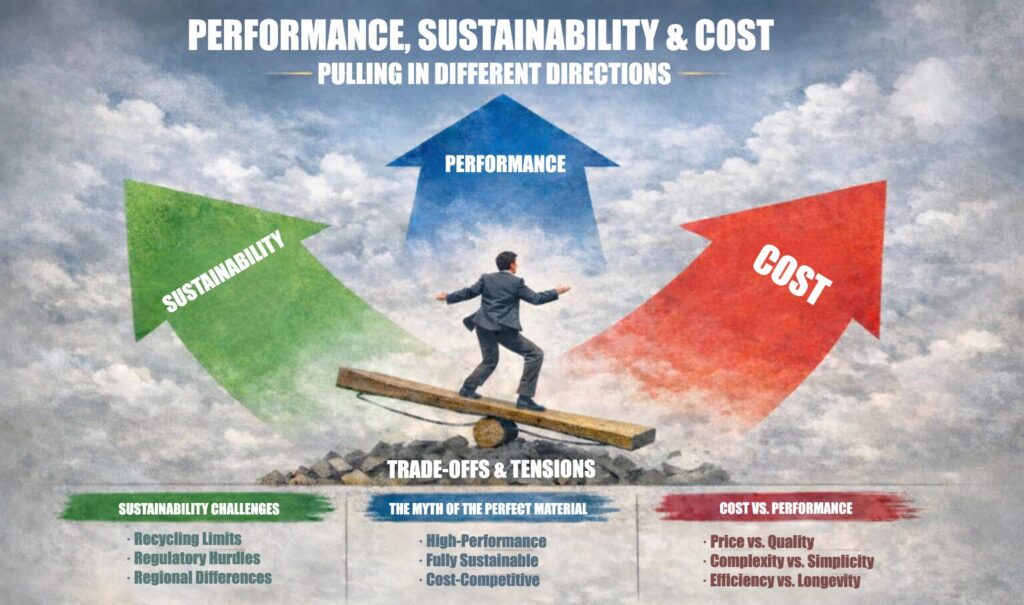
Material decisions are increasingly made under tension.
Performance requirements are rising.
Sustainability expectations are accelerating.
Cost pressure has not gone away (but is always increasing).
In most real-world situations, these 3 forces do not move in the same direction.
The myth of the perfect material
There is a common expectation that innovation will eventually deliver a material that is:
- High-performing
- Fully sustainable
- Cost-competitive
In practice, such “perfect” materials are rare — and when they exist, they often depend on scale, infrastructure, and ecosystem readiness that take years to develop.
Most material decisions therefore involve trade-offs, not optimizations.
Sustainability: ambition versus reality
Many materials with improved environmental profiles already exist today. However:
- They may carry a price premium due to limited production scale.
- Recycling or end-of-life solutions may depend on regional infrastructure that is unevenly developed.
- Regulatory acceptance may vary significantly across markets.
For companies operating internationally, sustainability is not a single standard.
A solution that works in one region may fail in another due to differences in recycling systems, legislation, or consumer behavior.
The challenge is not choosing “the greenest material”, but identifying when and where a material can realistically deliver its intended impact.
Performance under pressure
At the same time, performance requirements continue to increase:
- Longer shelf life.
- Higher mechanical resistance.
- Better thermal or chemical stability.
- More demanding processing conditions.
Reducing material complexity can improve recyclability, but may compromise performance.
Adding layers or functionality can improve performance, but complicate circularity.
These are not contradictions — they are design tensions that must be managed deliberately.
Cost is not just a number
Cost discussions often focus on unit price. Yet material choices influence:
- Scrap rates.
- Processing efficiency.
- Time-to-market.
- Requalification and redesign costs.
- Regulatory risk and future compliance.
A lower-cost material that triggers redesigns or limits market access can quickly become the most expensive option.
Managing trade-offs as a capability
The companies that navigate this complexity most effectively do not search for perfect answers.
They build capabilities:
- Early cross-functional alignment between R&D, procurement, regulatory, and marketing.
- Scenario-based thinking instead of single-point decisions.
- Flexibility to adapt material choices as scale, regulation, and infrastructure evolve.
- Access to multiple material options rather than dependency on a single solution.
In this context, material strategy becomes a decision-making framework, not a fixed choice.
The takeaway
Performance, sustainability, and cost will continue to pull in different directions.
The competitive advantage will not belong to companies that promise to eliminate trade-offs, but to those that understand them, anticipate them, and manage them better than others.
In material-intensive industries, success comes from making informed choices early – and keeping optionality alive for what comes next.