Polyketone vs. Nylon 6 and Nylon 66: Evaluating Hyosung POKETONE™ for Dimensional Stability

Why Engineers Look for Alternatives to Nylon 6 & Nylon 66
Nylon 6 and Nylon 66 are widely used engineering plastics in automotive, electrical, industrial, and consumer applications. They are proven materials with a long track record, offering a strong balance of mechanical strength, toughness, heat resistance, processability, and cost.
However, in some applications, the same strengths that make nylon familiar are not enough to eliminate design risk. Engineers may still face concerns related to moisture absorption, dimensional change, property variation after conditioning, supply uncertainty, or price volatility.
For parts that require tight dimensional control, stable assembly behavior, or consistent performance over time, these issues can become more than material characteristics. They can become production, quality, or warranty concerns.
That is why engineering teams may search for a Nylon 6 alternative, a Nylon 66 alternative, or a PA66 alternative material.
One material worth evaluating is Hyosung POKETONE™ polyketone.
POKETONETM is not a universal replacement for every nylon application. However, for selected applications where moisture absorption, dimensional stability, wear performance, chemical resistance, or material diversification are important, polyketone may be a practical candidate for evaluation.
Moisture Absorption: The Hidden Design Risk in Nylon Parts
One of the most important technical concerns with Nylon 6 and Nylon 66 is moisture absorption.
Polyamides absorb moisture from the surrounding environment. This can affect both part dimensions and mechanical properties. Research on PA66 has shown that water absorption can be associated with hygroscopic swelling and changes in mechanical behavior, including stiffness and strength changes depending on conditioning state (Wetzel et al., 2023).
For molded plastic components, this means that dry-as-molded datasheet values may not fully represent how a part behaves in real-world service. After molding, a component may be exposed to humidity, water, heat, automotive fluids, or changing environmental conditions.
For engineers, the key question is not only:
“Is Nylon 6 or Nylon 66 strong enough?”
A more practical question is:
“Will this part maintain the required dimensions and performance after moisture exposure?”
This is especially important for components such as:
- Precision molded parts
- Clips and fasteners
- Connectors and housings
- Gears and sliding components
- Automotive interior and exterior parts
- Under-hood components
- Parts with tight assembly tolerances
Environmental exposure and moisture absorption can influence the dimensional stability of PA6 and PA66 components. In one study of injected PA6 and PA66 components, PA6 showed higher moisture absorption capacity than PA66 under the tested conditions, and moisture-related dimensional variation was identified as relevant to component functionality and assembly (Clavería et al., 2016).
Why Dimensional Stability Matters in Automotive Applications
In automotive applications, dimensional stability can be just as important as mechanical strength.
A part may meet initial mechanical requirements but still create problems if dimensions shift after conditioning or environmental exposure. Moisture-related dimensional change may affect:
- Fit and assembly performance
- Connector alignment
- Clip retention force
- Gear engagement
- Bearing clearance
- Housing stability
- Noise, vibration, and harshness behavior
- Long-term part reliability
These risks matter because small dimensional changes can create larger downstream issues. A connector that does not align properly, a clip that loses retention consistency, or a sliding component that changes clearance can create quality problems beyond the material itself.
This is where a dimensionally stable engineering plastic or an engineering plastic with lower moisture absorption may become valuable.
Where POKETONETM Can Fit in the Material Selection Process
POKETONETM can be considered when a nylon-based design is exposed to moisture-related dimensional concerns, property-retention concerns, or commercial sourcing challenges.
Available technical data shows that POKETONETM base resin has lower reported moisture absorption than PA6/PA66 under the listed test conditions. The same data also reports lower saturated water absorption for POKETONETM compared with PA6/PA66 (Hyosung Chemical, 2023).
| Property | POKETONE TM Base Resin | PA6 / PA66 |
| Moisture absorption at 50% RH, 23°C | 0.5% | 1.6% |
| Water absorption at saturation, 23°C | 2.0% | 10.0% |
This comparison is important because many nylon replacement discussions are not about finding a “stronger plastic” in a general sense. They are about solving a specific problem.
For example:
“Can we reduce moisture-related dimensional change?”
“Can we maintain more consistent assembly performance?”
“Can we reduce design margin caused by water absorption?”
“Can we evaluate another material before a supply or price issue becomes urgent?”
For these questions, POKETONETM may deserve a place in the material evaluation process.
Polyketone Is Not Only About Low Moisture Absorption
Low moisture absorption is an important reason to evaluate polyketone, but it should not be the only reason.
The stronger story is the balance of multiple properties.
POKETONE™ is positioned for applications requiring chemical resistance, impact resistance, dimensional stability, fuel resistance, abrasion resistance, and performance in demanding industrial or automotive environments.
This matters because material substitution decisions are rarely based on one property alone. A successful replacement candidate often needs to satisfy several requirements at the same time:
- Lower moisture absorption than nylon
- Dimensional stability
- Mechanical strength
- Impact resistance
- Wear or sliding performance
- Chemical resistance
- Hydrolysis resistance
- Processability
- Commercial availability
In this type of application, POKETONE™ may create value not by being a simple one-for-one replacement, but by helping engineers balance multiple performance requirements in one material.
Nylon 6 / Nylon 66 vs. Polyketone: What Engineers Should ComparePolyketone Is Not Only About Low Moisture Absorption
Low moisture absorption is an important reason to evaluate polyketone, but it should not be the only reason.
The stronger story is the balance of multiple properties.
POKETONETM is positioned for applications requiring chemical resistance, impact resistance, dimensional stability, fuel resistance, abrasion resistance, and performance in demanding industrial or automotive environments (Hyosung Chemical, 2022).
This matters because material substitution decisions are rarely based on one property alone. A successful replacement candidate often needs to satisfy several requirements at the same time:
- Lower moisture absorption than nylon
- Dimensional stability
- Mechanical strength
- Impact resistance
- Wear or sliding performance
- Chemical resistance
- Hydrolysis resistance
- Processability
- Commercial availability
In this type of application, POKETONETM may create value not by being a simple one-for-one replacement, but by helping engineers balance multiple performance requirements in one material.
Nylon 6 / Nylon 66 vs. Polyketone: What Engineers Should Compare
When evaluating polyketone against Nylon 6 or Nylon 66, engineers should compare the materials based on the actual application requirements, not only generic datasheet values.
| Evaluation Point | Nylon 6 / Nylon 66 | Polyketone Positioning |
| Moisture absorption | Can absorb moisture and experience dimensional or property changes | Lower moisture absorption may support dimensional stability |
| Dimensional stability | Application-dependent; may require design margin | Worth evaluating for moisture-sensitive parts |
| Mechanical strength | Strong and widely used | Strong candidate depending on grade and part design |
| Stiffness retention | Can change after moisture conditioning | Should be evaluated where property retention matters |
| Impact resistance | Good in many grades | Relevant where toughness is required |
| Wear performance | Good in selected grades | Relevant for sliding and moving components |
| Chemical resistance | Depends on grade and chemical exposure | Worth evaluating in chemical-contact environments |
| Processing | Familiar and widely processed | Requires grade-specific processing review |
| Application fit | Established and proven | Candidate material for targeted replacement projects |
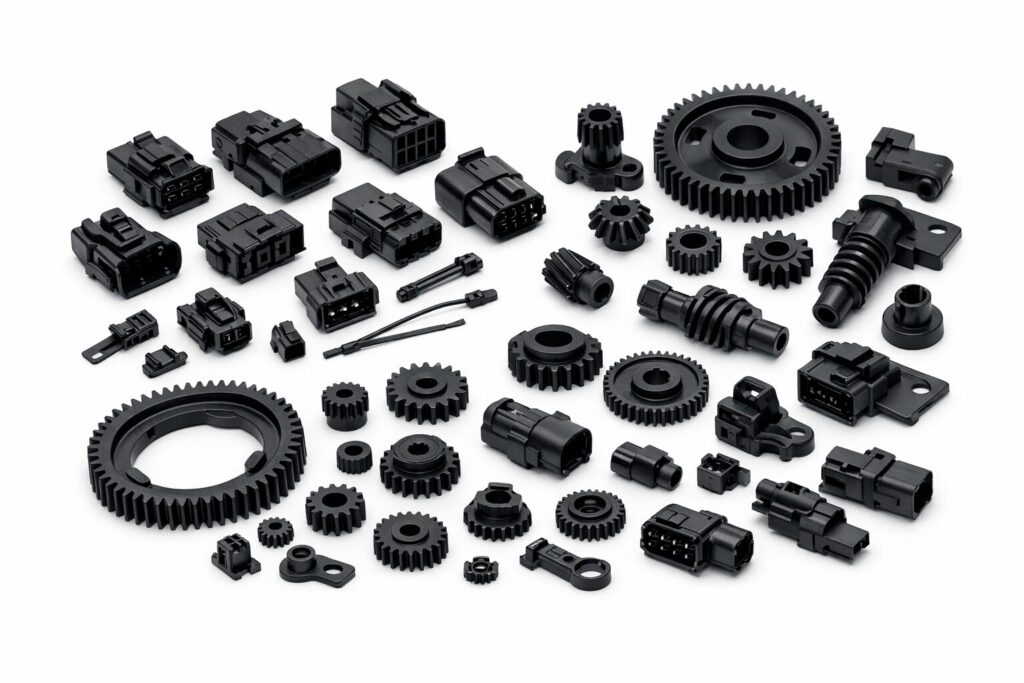
The practical question is not whether polyketone should replace all Nylon 6 or Nylon 66 applications. It should not.
The better question is:
Where does Nylon 6 or Nylon 66 create moisture, dimensional, wear, chemical, or sourcing challenges that justify evaluating another engineering plastic?
Applications Where POKETONETM May Be Worth Evaluating
POKETONETM may be worth evaluating in applications where Nylon 6 or Nylon 66 creates concerns related to moisture absorption, dimensional change, property retention, or long-term consistency.
Precision Molded Components
Precision molded parts often require tight dimensional control. If moisture-related dimensional change affects fit, assembly, or function, polyketone may be worth testing as an alternative material.
Clips and Fasteners
Clips and fasteners often need consistent retention force over time. If moisture absorption changes stiffness or dimensions, retention behavior may change. A material with lower moisture absorption may help reduce this risk.
Connectors and Housings
Connectors and housings often require dimensional stability, impact resistance, insulation performance, and reliable assembly. POKETONETM may be relevant where nylon parts face dimensional-stability or chemical-resistance limitations.
Gears and Sliding Components
In gear or sliding applications, wear, friction, noise, dimensional consistency, and mating-material behavior can all matter. POKETONETM may be worth evaluating where a part needs both wear performance and dimensional consistency.
Chemical-Contact or Wet Environments
Where parts may contact water, cleaning agents, automotive fluids, salts, or other chemicals, chemical resistance and hydrolytic stability become important. Polyketone may be relevant where nylon’s moisture behavior or chemical exposure profile creates performance concerns.
A Practical Framework for Nylon Replacement Projects
Many material searches start with broad phrases such as “Nylon 66 replacement,” “alternative to Nylon 6,” or “PA66 alternative material.”
However, the best replacement material depends on why the current material is being reconsidered.
| Current Issue with Nylon | Why It Matters | Why Evaluate POKETONETM |
| Moisture absorption | May affect dimensions and mechanical properties | Lower water uptake may support dimensional stability |
| Tight tolerances | Dimensional change may affect assembly | May reduce moisture-related design risk |
| Loss of stiffness after conditioning | Performance may change in use | Property retention can be evaluated by grade and application |
| Wear or friction | Durability and noise may be affected | May be relevant for sliding components |
| Chemical exposure | Fluids may limit material performance | Chemical resistance may support demanding applications |
| Supply or pricing concern | Long-term sourcing strategy may need alternatives | Can be evaluated as part of material diversification |
This framework helps position POKETONETM correctly. It should not be marketed as a generic “better nylon.” Instead, it should be evaluated for applications where nylon’s moisture behavior, dimensional change, wear performance, chemical resistance, or sourcing profile creates a specific challenge.
When POKETONETM May Not Be the Right Fit
POKETONETM is not the right answer for every Nylon 6 or Nylon 66 application.
Material selection should always be based on application-specific requirements, including:
- Operating temperature
- Mechanical load
- Chemical exposure
- Moisture exposure
- Tolerance requirements
- Processing method
- Cost target
- Regulatory requirements
- OEM or Tier approval process
In some applications, Nylon 6, Nylon 66, PBT, POM, PPS, or another engineering plastic may remain the better choice.
This is important. A credible material evaluation should begin with the part requirements, not with a preferred resin name. POKETONETM should be considered when the application needs a strong balance of dimensional stability, low moisture absorption, mechanical performance, impact resistance, wear performance, and chemical resistance.
How Mitsui Plastics Can Support POKETONETM Evaluation
Mitsui Plastics supports customers evaluating engineering plastic materials for automotive and industrial applications.
For companies currently using Nylon 6 or Nylon 66, Mitsui Plastics can help review whether Hyosung POKETONETM may be suitable for applications involving:
- Moisture-sensitive performance requirements
- Dimensional stability concerns
- Nylon 6 or Nylon 66 replacement projects
- PA66 alternative material evaluations
- Wear or sliding requirements
- Chemical or wet-environment exposure
- Automotive material development
- New application development
Mitsui Plastics can also help coordinate grade selection, sample availability, commercial discussions, and communication with technical resources.
Frequently Asked Questions
Is polyketone a replacement for Nylon 6?
Polyketone can be evaluated as a potential alternative to Nylon 6 in selected applications, especially where moisture absorption, dimensional stability, wear performance, or chemical resistance are concerns. It is not a universal replacement, and performance should be confirmed based on the specific grade, part design, and application conditions.
Is polyketone a replacement for Nylon 66?
Polyketone may be considered for Nylon 66 or PA66 replacement projects depending on the application requirements. Engineers should compare temperature exposure, mechanical load, dimensional tolerance, moisture exposure, chemical environment, and processing requirements before making a material change.
Why does nylon moisture absorption matter?
Moisture absorption can affect part dimensions and mechanical properties. In precision components, connectors, clips, gears, housings, and other tight-tolerance applications, these changes may affect assembly, fit, retention force, or long-term performance (Wetzel et al., 2023; Clavería et al., 2016).
What makes POKETONETM different?
POKETONETM combines low moisture absorption, dimensional stability, impact resistance, chemical resistance, fuel resistance, and wear-performance potential. This combination may make it useful in selected applications where nylon’s moisture behavior creates design or performance concerns (Hyosung Chemical, 2022, 2023).
Who can help evaluate POKETONETM in North America?
Mitsui Plastics can support customers in North America with application review, grade-selection discussions, sample availability, commercial coordination, and communication with technical resources.
Conclusion: Consider POKETONETM When Nylon’s Moisture Behavior Becomes a Design Risk
Nylon 6 and Nylon 66 remain proven and valuable engineering plastics. They are widely used for good reasons.
However, in applications where moisture absorption leads to dimensional change, stiffness variation, assembly concerns, or performance uncertainty, engineers may need to evaluate alternative materials.
Hyosung POKETONETM offers a compelling material profile for selected applications requiring dimensional stability, low moisture absorption, impact resistance, chemical resistance, and wear performance.
For engineering teams seeking a Nylon 6 alternative, Nylon 66 alternative, PA66 alternative material, or dimensionally stable engineering plastic, POKETONETM may be worth evaluating.
Interested in evaluating POKETONETM as an alternative to Nylon 6 or Nylon 66? Contact Mitsui Plastics to discuss your application requirements and available grade options.

References
Clavería, I., Elduque, D., Santolaria, J., Pina, C., Javierre, C., & Fernandez, A. (2016). The influence of environmental conditions on the dimensional stability of components injected with PA6 and PA66. Polymer Testing, 50, 15–25. https://doi.org/10.1016/j.polymertesting.2015.12.008
Hyosung Chemical. (2022). POKETONE catalogue 2022 [Product catalogue]. https://www.hyosungchemical.com/en/customer/download-center/172
Hyosung Chemical. (2023). POKETONE technical material for automotive applications [Technical material]. https://www.hyosungchemical.com/upload/board/20231010/f3473680-940a-42c2-a414-6fe4dad9bfd0.pdf
Wetzel, P., Sambale, A. K., Uhlig, K., Stommel, M., Schneider, B., & Kaiser, J.-M. (2023). Hygromechanical behavior of polyamide 6.6: Experiments and modeling. Polymers, 15(16), Article 3387. https://doi.org/10.3390/polym15163387