Recycled PP and TPO for Automotive Parts: A Practical Path to Sustainable Performance
As automotive manufacturers accelerate toward sustainability targets, materials selection is moving beyond cost and performance alone. Today, engineering and procurement teams face a new challenge: how to incorporate recycled content without introducing unnecessary risk.
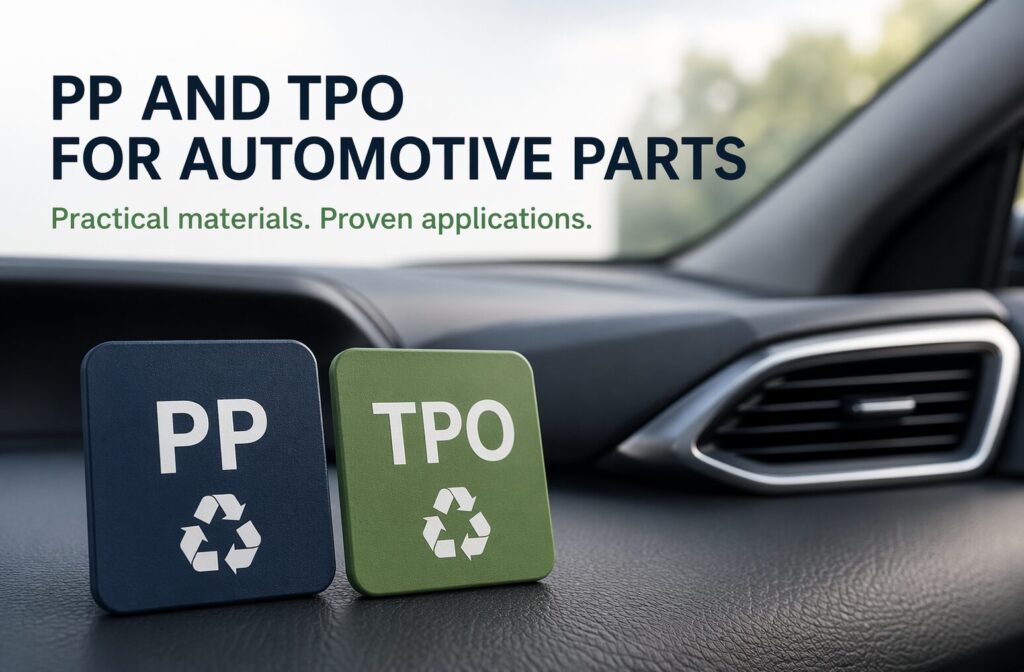
For many, the answer begins with a smart, pragmatic approach—starting with materials already proven in automotive applications. That’s where recycled polypropylene (PP) and thermoplastic polyolefin (TPO) stand out.
Why Start with PP and TPO?
PP and TPO are already some of the most widely used plastics in vehicles today. From interior trim and door panels to exterior components and underbody shields, these materials are deeply embedded in automotive design and manufacturing processes.
Because they are familiar and extensively validated across applications, they provide a low-friction entry point for recycled-content programs. Instead of introducing entirely new material systems, teams can build on existing knowledge, tooling, and supply chains.
In short:
- Proven processing behavior
- Established performance benchmarks
- Broad application coverage
This foundation reduces uncertainty and speeds up evaluation—two key priorities for automotive development cycles.
Selecting the Right Applications for Recycled Materials
A common misconception in sustainable materials is viewing recycled plastics as a universal replacement for virgin resins.
But the more effective question isn’t:
“Can recycled PP or TPO replace virgin materials everywhere?”
Instead, it is:
“Where can recycled-content materials deliver the required performance while keeping risk under control?”
Every automotive application comes with its own set of demands—from impact strength and stiffness to heat resistance and surface appearance. Success comes from matching material capabilities to those specific requirements—not from attempting a blanket replacement across all parts.
What the Data Tells Us
Performance data shows that recycled PP can retain a significant portion of its mechanical properties after processing—especially when formulated thoughtfully.
- Neat recycled PP may retain around 80–85% of key properties
- Talc-filled PP can maintain 90%+ performance, making it particularly attractive for structural or semi-structural parts
This highlights an important point:
Formulation matters just as much as recycled content.
Similarly, thermal aging studies demonstrate that properly engineered recycled PP compounds can maintain mechanical performance over time—supporting their use in demanding automotive environments.
Where Recycled PP and TPO Fit Best
Rather than targeting high-risk applications first, successful programs begin with components that offer the best balance of performance tolerance and sustainability impact.
Ideal starting points include:
- Interior trim components
- Door panels and consoles
- Pillar trim
- Non-Class A surfaces
- Hidden brackets and supports
- Underbody shields
- Covers and housings
These applications allow teams to integrate recycled content without compromising safety, durability, or customer-visible quality.
More demanding components—such as Class A exterior surfaces or low-temperature impact-critical parts—may require additional validation.
How MPI Supports Your Transition
How Mitsui Plastics Supports Your Transition
Mitsui Plastics, Inc. (MPI) brings a unique advantage to automotive material innovation: breadth, expertise, and flexibility.
With a comprehensive portfolio—including PP, TPO, TPV, engineering plastics, elastomers, additives, and custom compounds—MPI helps customers evaluate multiple material pathways, not just one.
Our capabilities include:
- Post-consumer recycled (PCR) PP and TPO options
- Formulations with 20–30% recycled content
- Application-specific material recommendations
- Support for performance validation and material comparison
- Supply chain consistency and sourcing expertise
Rather than pushing a single solution, Mitsui Plastics works alongside your team to identify where recycled materials make sense—and where they don’t.
Start Where It Matters Most
Sustainability in automotive manufacturing isn’t about making sweeping changes overnight. It’s about making smart, data-driven decisions—starting where the opportunity is largest and the risk is manageable.
PP and TPO offer exactly that opportunity.
By focusing on the right applications, validating performance, and leveraging experienced partners like Mitsui Plastics, automotive teams can confidently move toward circular material strategies—without compromising quality or reliability.
Ready to Evaluate Recycled PP or TPO?
If your team is exploring recycled-content plastics for automotive applications, Mitsui Plastics can help you:
- Compare candidate materials
- Align recycled-content targets with part requirements
- Navigate validation and performance considerations
Article by Nagisa Kratz